Wednesday, December 7, 2011


The Mystery of Ernest Hemingway


On Sunday July 2,1961 Ernest Hemingway was found in his house dead. Witnesses reported that he picked out his favorite clothes and then shot himself. Now the question we are all forced to ask is why would someone so talented do that to himself?. His wife Mary Hemingway took months to finally admit her husband's death was a suicide. His wife had reportedly stated, "he was a perfect man".

Hemingway was a great writer but once he hit rock bottom of his life, he decided he couldn't write any more, so his choice was to just give up. From his long history of poor health, he had high blood pressure, rapid weight loss, skin disease and other complications. His body couldn't take it any more and was breaking down. So at sixty one years old, the author killed himself and left behind many loved ones in shock and plenty of fans of his writing.

Hemingway stated that" Fear of death increases in exact proportion to increase in wealth." By this quote you can tell he was in a depression. Ernest Hemingway suffered from major depression in the last years of his life. His depression was so severe he was even admitted to the Mayo Clinic in Minnesota. In 1961 he received a series of electroshock treatments, which did more harm than good to him.

For the last twenty years of his life he was drinking a quart of whiskey a day.

--Vanessa and Jessica

Tuesday, December 6, 2011

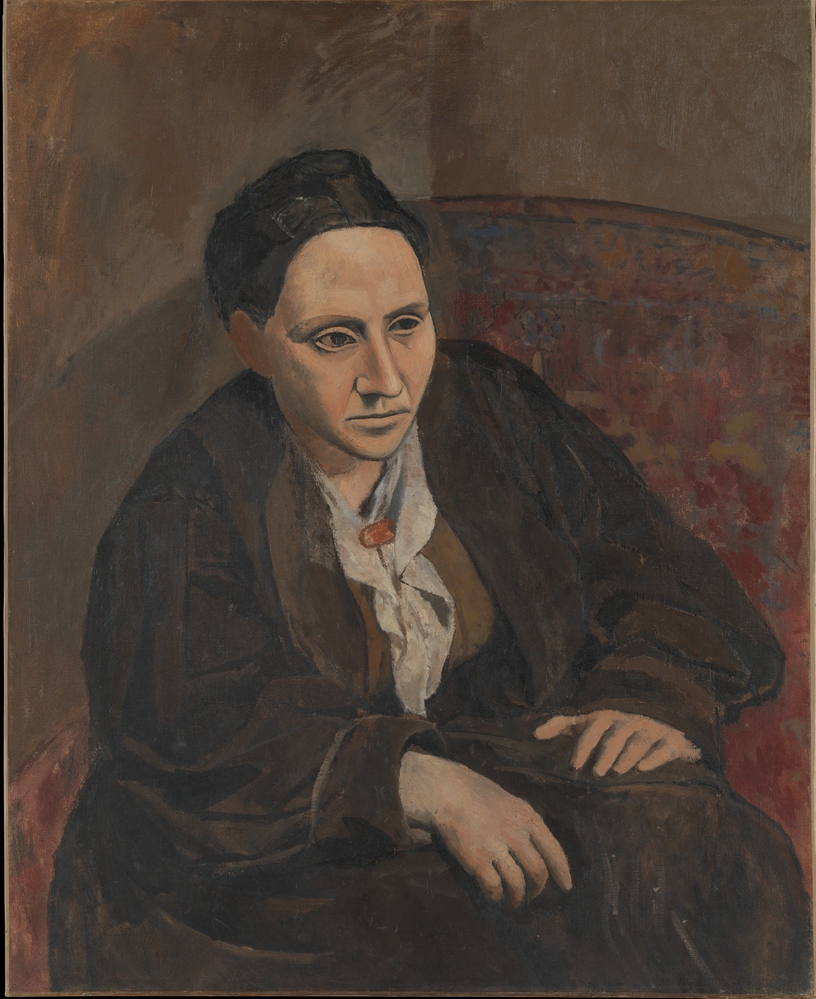
Gertrude Stein

Gertrude Stein was born on February 3rd, 1874 to Daniel and Amelia Stein. Her father was a railroad executive who became wealthy by investing in real estate and street cars. When Gertrude was 3 years old her family moved to Vienna and then Paris for business, but they moved back to the United States shortly after. When she was about 16 her mother died and three years later her father died too, her older brother arranged for them to live in Baltimore.

Between 1893 and 1897 she studied psychology under philosopher William James at Radcliffe College. After, she studied at John Hopkins, but left for Paris before she graduated. She lived with her brother for nine years, as he became an accomplished art collector and critic, and after she lived with Alice B. Toklas. She and her brother were one of the major collectors of experimental painters, and she became friends with many expatriate writers, poets, and artists, such as Ernest Hemingway. She became a very well respected critic of art and literature.

She became friends with many famous painters around Paris, like Pablo Picasso and Henri Matisse. Her art collection was considered to be one of the best in the world, and it gained a world wide reputation. In 1914 her older brother moved to Italy, and as a result their collection was split up. After their collection was split, she continued to collect, mostly John Gris’ and Pablo Picasso’s cubist work.

Gertrude Stein is also a famous writer, but her books never did as well as other writers of the “Lost Generation”, a term she gave to the people that came of age during the First World War. Her first best-seller, The Autobiography of Alice B. Toklas, was her autobiography. She admitted that writing her autobiography was a way to make money, and some of her friends thought it was too commercial or inaccurate, and Ernest Hemingway called it a “damned pitiful book.”


http://en.wikipedia.org/wiki/Gertrude_Stein

http://writing.upenn.edu/~afilreis/88/stein-bio.html


By Safwan and Ayush

Bullfighting
Bullfighting is a national game in Spain. People there also call it “terero”. It traces its past to bull worship and sacrifice. It is a game in which bulls are fighting against each other or a bull is pitted against a human, which makes people there very entertained. It is also called a “blood sport” by its detractors because many bulls and people have lost their lives over its long history, but its followers think that it's the finest art ever. People love it. Bullfighting involves professional "toreros" who have learned formal maneuvers and can innovate according to the bullfighter’s style. In this game the bullfighter is at great risk of being crushed or trampled. There are certain levels which also include grabbing and holding the bull by its horns when it runs at them which are very dangerous. The danger is also enhanced by waving red flags to make the bull more furious.


Although people really have fun and enjoy it, they rarely realize that animal rights are being destroyed by this bloody sport resulting in the suffering of many bulls, horses and humans. Many people are losing their lives but the ones who enjoy it really don't care. They are having fun but they don’t recognize that this reckless sport is risking so many people’s lives.

Hemingway meets Fitzgerald


Although F. Scott Fitzgerald was one of Ernest Hemingway's earliest supporters, the feeling was not necessarily mutual. Hemingway had mixed feelings about the friend and his writing, and overall had very little (if any) respect for him. Their relationship began in 1925, when Fitzgerald brought Hemingway and his later editor, Maxwell Perkins, together.

A rift began to form between the two when Fitzgerald wrote a confession entitled "The Crack-Up," in which Hemingway felt that Fitzgerald was demeaning himself. Hemingway also spoke unkindly of him in a short story titled "The Snows Of Kilimanjaro". However, Fitzgerald was patient with the insult, and did not speak ill of the other. Just before Fitzgerald's death in 1940, he wrote a letter to Hemingway in a publication, saying that he envied him without irony. After his death Hemingway described Fitzgerald was "almost like a guided missile with no one guiding him."

Much of Hemingway's criticism of Fitzgerald sprang from his belief that Fitzgerald would have accomplished more if not for his wife, Zelda Fitzgerald. He referred to Fitzgerald's talent as "wasted", and cites his wife as the cause of this, saying that every time he was ready to take his work seriously, she would become jealous of his talent and knock him back down.

One irony about Hemingway's disrespect for Fitzgerald was that Hemingway faulted alcohol in part for Fitzgerald's wasted talent. Hemingway himself definitely had some problems with alcoholism, so it’s a bit ironic that he would accuse Fitzgerald of such, and criticize his writing for it. He admitted to being fond of alcohol himself, but said that for Fitzgerald alcohol was "a straight poison instead of a food."

Overall, their relationship was definitely unbalanced. While Fitzgerald had respect and admiration for Hemingway and his work, the latter claimed many times that he never had any respect for Fitzgerald, and continued to have strong opinions of the man after his death.

-- Elayna and Tiara

(Source: nytimes.com, New York Times "Hemingway's Letters Tell Of Fitzgerald".)

Bull Run


The Running of the Bulls is a practice that involves running in front of a small group of bulls that are let loose within the streets of Spain, Pamplona, and Mexico.

The purpose of this event was in origin to transport the bulls from the off-site where they had spent the night, to the bullring where they would be killed in the evening. Youngsters would jump among them to show off their bravado.

Spanish lore says the true origin began in North-eastern Spain during the early 14th century. While transporting cattle in order to sell at the market, men would attempt to speed the process by hurrying their cattle using tactics of fear and excitement. After years of this practice, the transportation and hurrying began to turn into a competition, as young adults would attempt to race in front of the bulls and make it safely to their pens without being overtaken. When the popularity of this practice increased and was noticed more and more by the expanding population of Spanish cities, a tradition was created and stands to this day.

The event of Running of the Bulls is connected to Ernest Hemingway because he wrote about the San Fermin festival in Pamplona. He also writes about how graphic the running of the bulls was in his book The Sun Also Rises.